

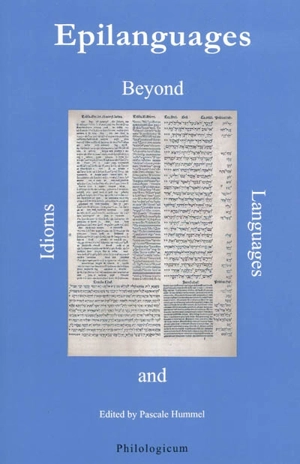
Epilanguages : beyond idioms and languages
Versailles, Lyon 2ᵉ, Lyon 6ᵉ...

Ce que dit l'éditeurEpilanguages In the history of scholarship, scholars daily practicing vernacular idioms have successively been writing and/or speaking Latin and English as the vehicular languages used to communicate texts and ideas. Somewhere between archiphonemes / archisemes and metalanguages, which could be considered semi-synonyms, the « epilanguages » are the linguistic realities and results generated by the use of a second language for scholarly and scientific purposes. What kind of thought does a scholar produce when (s)he uses these epilanguages (mostly Latin or English) ? How does (s)he think, and what does (s)he write ? How differently does his/her thinking and writing work when (s)he uses the vehicular (epilinguistic) tools ? The contributors to this volume investigate how in the present and in the past the conceptual and linguistic shifting from the vernacular to the vehicular has generated what we could call an « epilinguistic » way of thinking. To what extent are the texts created in this way more far-distant from their mental sources, even maybe sounding « schizophrenic » (i.e. cut-off from reality), than the texts the same scholar would write in his own idiom ? What are the specific characteristics of these texts : objectivity, cerebrality, artificiality, epiphenomenality, coldness, impersonality, conventionality, formularity, stereotypicality, or other traits one may think of ? The contributors question their own experience as much as the historical examples available from the different centuries of history of scholarship. All the fields of science and knowledge (outside of philology and linguistics themselves) are being explored. |
RésuméLes chercheurs s'interrogent sur le phénomène de passage conceptuel et linguistique d'une langue vernaculaire à une langue véhiculaire (hier le latin, aujourd'hui l'anglais), ce qu'ils désignent sous le nom de voie épilinguistique de la pensée. ©Electre 2026 |
Caractéristiques Éditeur(s) Date de parution
27 décembre 2009
Collection(s)
Philologicum
Rayon
Linguistique française et étrangère
Contributeur(s) Pascale Hummel-Israel
(Directeur de publication), Pascale Hummel-Israel
(Auteur) EAN
9782917741153
Nombre de pages
235
pages
Reliure
Broché
Dimensions
24.0
cm x
16.0
cm x
1.4
cm
Poids
435
g
|