

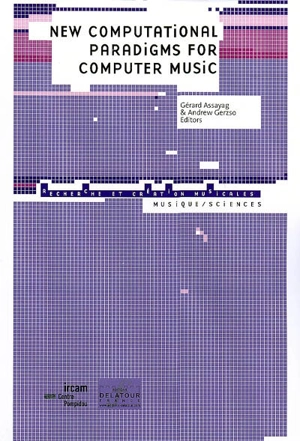
New computational paradigms for computer music
Versailles, Lyon 2ᵉ, Lyon 6ᵉ...

Ce que dit l'éditeurNew computational paradigms for computer music. Much of today's computer music technology, both hardware and software, is based on computational paradigms that were present when the field emerged more than thirty years ago. IRCAM's research, motivated by specific musical goals, has frequently been on the cutting edge of computer science. The development of real-time systems (e.g. 4X, Max/MSP), object oriented languages (Formes), constraint programming (Situation), and visual programming languages (OpenMusic) are some examples. Today, many of computer music's major developments have reached a certain conceptual and technical maturity. In order to forecast coming evolutions, it is vital to examine the new computational paradigms that are emerging in computer science in order to evaluate their relevance and potential for musical applications in the years ahead. On the one hand, the new ideas could serve as a source of inspiration for musical projects, and on the other they could serve as solutions for known - but up to now unsolved - problems. At the same time, some problems encountered in computer music - such as the representation of time in its different musical forms - could be a source of interest to the computer science community. The colloquium on New Computational Paradigms for Computer Music, held at IRCAM on June 11th, 2007, brought together major figures in the fields of both computer science and music in order to encourage exchanges on different levels and outline new perspectives for the future. This book is a record of that important event and includes new and re-formulated material. |
RésuméLe langage musical utilisé par les logiciels dépend des modèles conceptuels (les paradigmes) inventés par les programmeurs et les chercheurs en informatique musicale. Quels sont les paradigmes informatiques récents qui permettent d'élargir le vocabulaire de la musique ? ©Electre 2026 |
Caractéristiques Éditeur(s) Date de parution
15 juin 2009
Collection(s)
Musique-sciences
Rayon
Musique
Contributeur(s) Gérard Assayag
(Editeur scientifique (ou intellectuel)), Andrew Gerzso
(Editeur scientifique (ou intellectuel)) EAN
9782752100542
Reliure
Broché
Dimensions
26.0
cm x
18.0
cm x
cm
Poids
500
g
|